
Arc de Triomphe, Paris
Welcome to Issue XLI of Architecture Atlas. For people who travel for architecture and history.
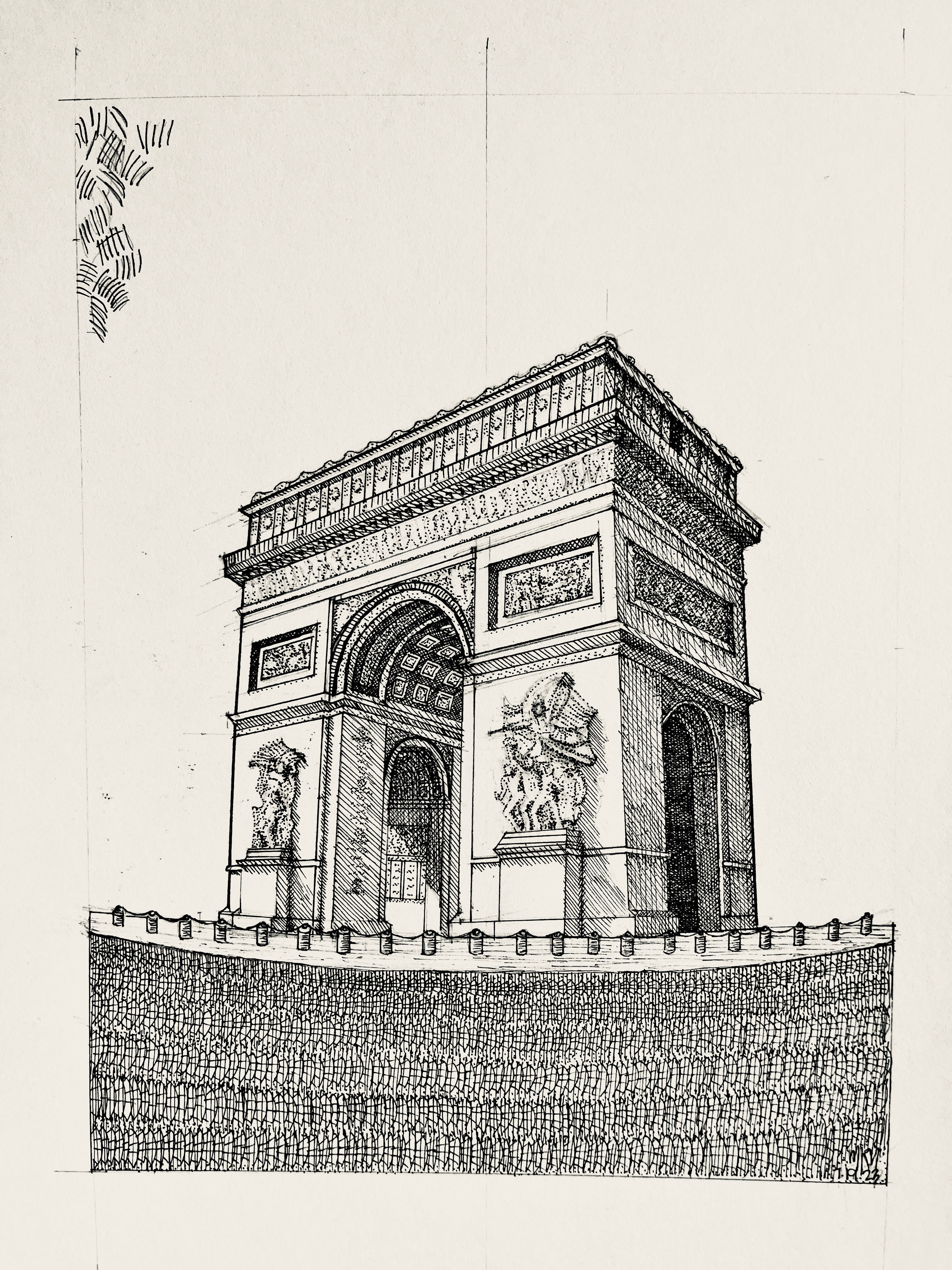
Origins
Located in the heart of Paris at the axis where twelve avenues converge is the monumental symbol of French patriotism.
Napoleon Bonaparte commissioned the Arc de Triomphe de l’Étoile (The Triumphal Arch of the Star) along with the Vendôme Column and the Arc de Triomphe du Carrousel to celebrate his recent victory at Austerlitz in 1805.
The massive Neoclassical arch designed by Jean-François-Thérèse Chalgrin stands 164ft (50m) and 148ft (45m) wide.
Napoleon wasn’t the first French ruler to be inspired by the triumphal arch, as Louis XIV had ordered the construction of two arches in Paris. Louis XIV’s arches were built in the 17th century in honor of his military victories.
While the main inspiration for the Arc de Triomphe was the 1st century AD Roman Arch of Titus, Louis XIV’s 17th century Porte Saint-Denis and the 4th century Roman Arch of Constantine were also influences.
The Arch of Titus is the oldest surviving Roman arch located along the Via Sacra near the Roman Forum in Rome.
It was one of 36 triumphal arches that were constructed in ancient Rome, and now only three remain: the Arch of Titus (81 AD), the Arch of Septimius Severus (203 AD) and the Arch of Constantine (315 AD).
Construction
Construction of the Arc de Triomphe began on August 15th, 1806 on Napoleon’s birthday. The foundation took two years to build.
After the fall of Napoleon and the arrival of Louis XVIII in 1814 construction halted and the arch was left unfinished.
Nearly a decade passed.
In 1823 Louis XVIII ordered the completion of the Arc de Triomphe.
Finally in 1836 after 30 years of construction, the Arc de Triomphe was completed.
There are four decorative relief sculptures on the facade, the most famous is François Rude’s Departure of the Volunteers of 1792, often called the La Marseillaise.
The scene shows the winged figure of Liberty leading French citizens to defend the Republic.
Late 19th century to present day
Only decades after the Arc de Triomphe was completed Baron Haussmann would redesign the city with 12 avenues converging at the Arc de Triomphe and transform the urban fabric of Paris.
Beneath the Arc de Triomphe lies the Tomb of the Unknown soldier with an eternal flame that is rekindled every evening. The tomb was added in 1921 after the first World War to honor France’s unidentified deceased.
The Arc de Triomphe today is still an iconic symbol of Paris. Bastille Day (French National Day) on July 14th starts its journey from the arch every year.
The right place to stay near this monument belongs to the Paris of Napoleon times.
Next week, the first edition of the Historic Hotel Guide: Where to Stay Inside History arrives alongside paid subscriptions.
This issue is an occasional architectural study of a single landmark that will become part of the Architecture Atlas paid subscription.
Deep Dives
If you’d like to learn more about the history check out the Seven Ages of Paris by Alistair Horne, it begins with the 12th century rise of Philippe Auguste and goes through post WWII.
For readers interested in a more in-depth look at France, subscribe to Pierre from French Moments.
He shares captivating stories about France, French life, and culture.
Next Thursday: Another destination through architecture and history.
Mary
P.S. From Napoleon’s Roman inspired monument to the axis of twelve radiating avenues. Send this to someone who needs to walk through the magnificent Arc de Triomphe.
How long did it take you to complete that pen-and-paper version? My goodness, you're a talented artist and writer. I've never been to Paris or Rome in person, but I have experienced them a bit virtually just now. :)
This was so interesting to read! I never knew the history of the Arc de Triomphe