

Discover places of wonder through architecture and history. Featuring pen illustrations of remarkable places. Explore: The Architecture Atlas Archive | The Places of Wonder Mail Club
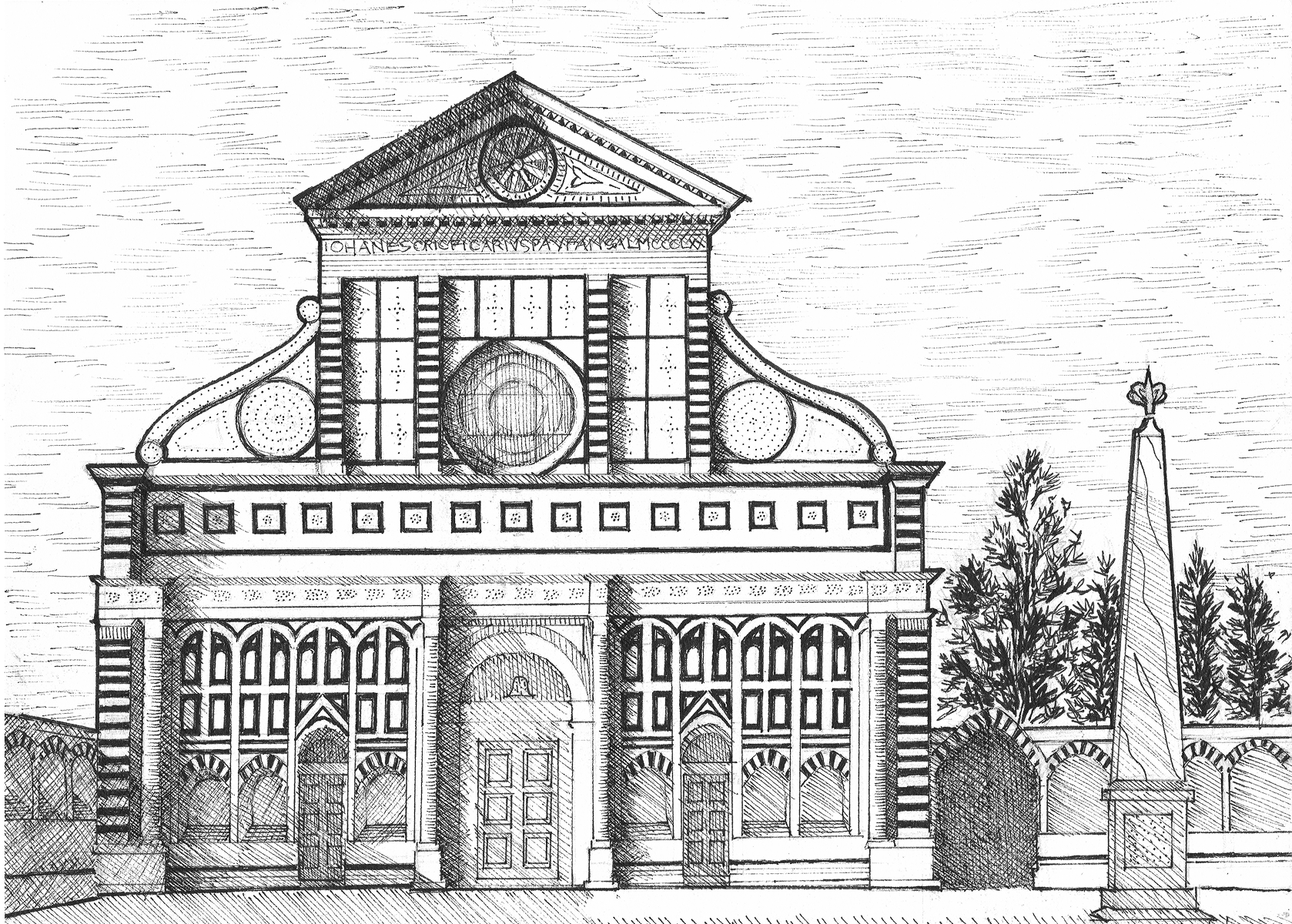
Places of Wonder No. 02
Santa Maria Novella
Florence | c. 1350
Overview
In the birthplace of the Renaissance stands a church that helped shape the movement in both architecture and art and more than a century later played a role in the reform of the calendar.
But first, a bit of history.
Origins
Deep in the heart of Tuscany is a town that began as the Roman colony of Florentia, founded in 59 BC.
As the (soon-to-be) Roman Empire expanded so did the town of Florentia. The town situated along the Arno river prospered and a Roman temple, amphitheater and public baths were added.
After the fall of the Western Roman Empire the town of Florentia fell to the Ostrogoths.
Throughout the early Middle Ages Florence was under the control of the Byzantines, the Lombards and in the 8th century under control of Charlemagne when he placed Margraves (princes of the Holy Roman Empire) in nearby Lucca to rule over Florence. The control of the Margraves helped strengthen churches and monasteries throughout Tuscany.
And it is during this period in the 9th century that the first church was established on what would become the site of Santa Maria Novella.
Santa Maria Novella
In 1221 the church was granted to the newly established Dominican order.
Two Dominican friars designed the basilica and cloister. Construction began in the 13th century and was completed in the 14th century with a Romanesque and Gothic Bell Tower (still standing). Additional Italian gothic features were added and this church was consecrated in 1420.
But the upper part of the facade you see today was designed by Leon Battista Alberti in the mid-1400s.
The Exterior
Through harmonizing the facade with the earlier medieval church, Leon Battista Alberti applied classically inspired proportions to create a unified whole and showcased Early Renaissance style and thought. The S-curved scrolls on the two sides of the upper facade are distinct and without ancient classical precedent.
Inspired by Roman architect Vitruvius’ book De Architectura, architect Leon Battista Alberti’s book On the Art of Building became the first major architectural treatise and influential guide to Renaissance architecture.
In 1572, astronomical instruments were added to the exterior of the lower facade by Ignazio Danti, astronomer of Cosimo I de’ Medici.
These instruments helped Danti measure and document the discrepancy between the solar year and the Julian calendar (still in use since proposed by Julius Caesar in Rome in 46 BC). The project contributed to the adoption of the Gregorian calendar in 1582. This is the calendar we still use today.
The Interior
Inside the basilica is a pulpit designed by Renaissance architect Filippo Brunelleschi in 1443. It was from this same pulpit in 1614 that Dominican friar Tommaso Caccini denounced Galileo Galilei’s support for the movement of the Earth, claiming it was contrary to scripture.
During a renovation in the 19th century a fresco was rediscovered behind the chapel. It was the Holy Trinity painted by Masaccio (1425-1426).
This painting is regarded as one of the first Renaissance paintings to use linear perspective.
Conclusion
From Alberti’s facade, to the Holy Trinity by Masaccio, Santa Maria Novella helped define the Early Renaissance in both architecture and art.
And its influence is still felt in the calendar that we still use today.
From the Studio
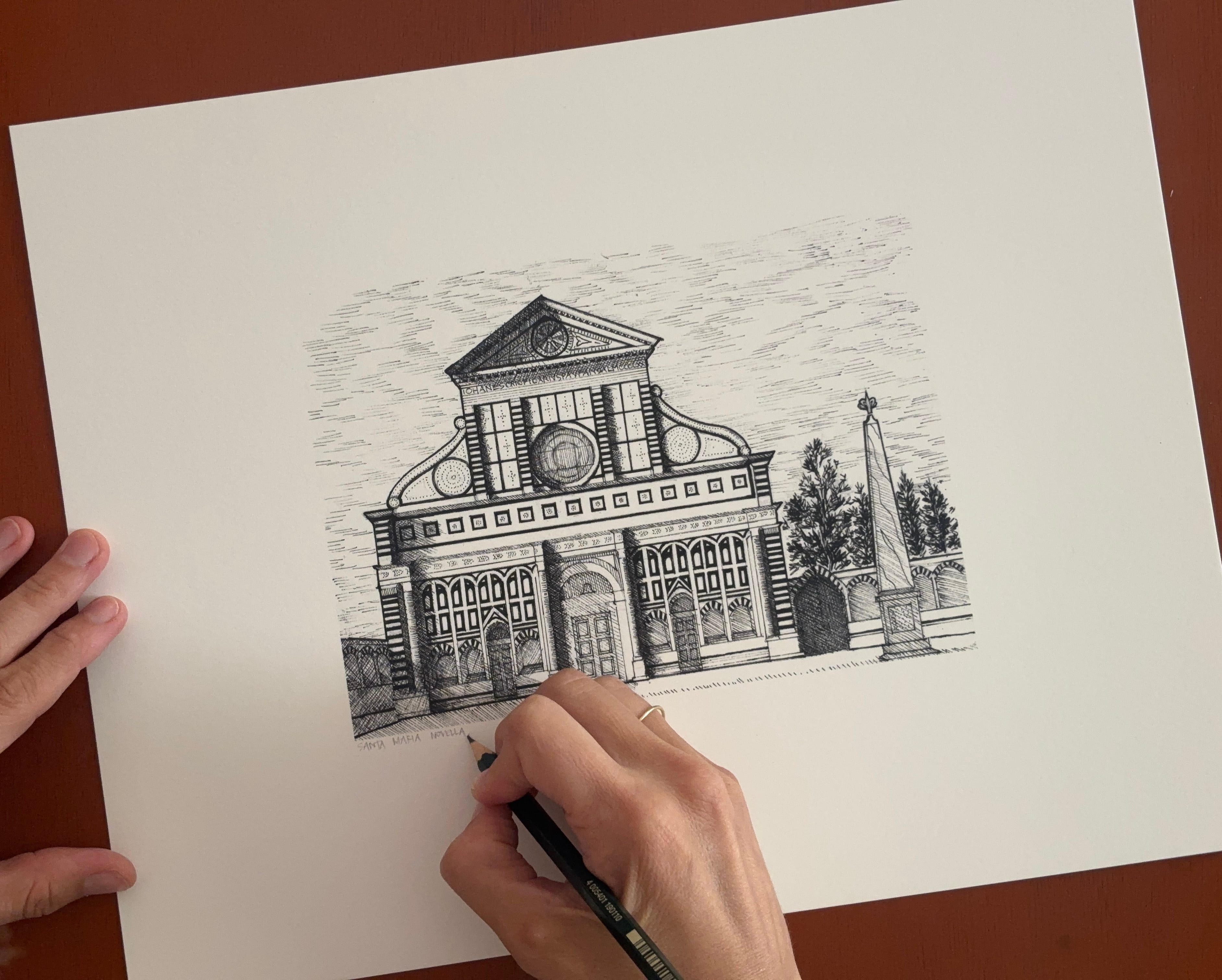
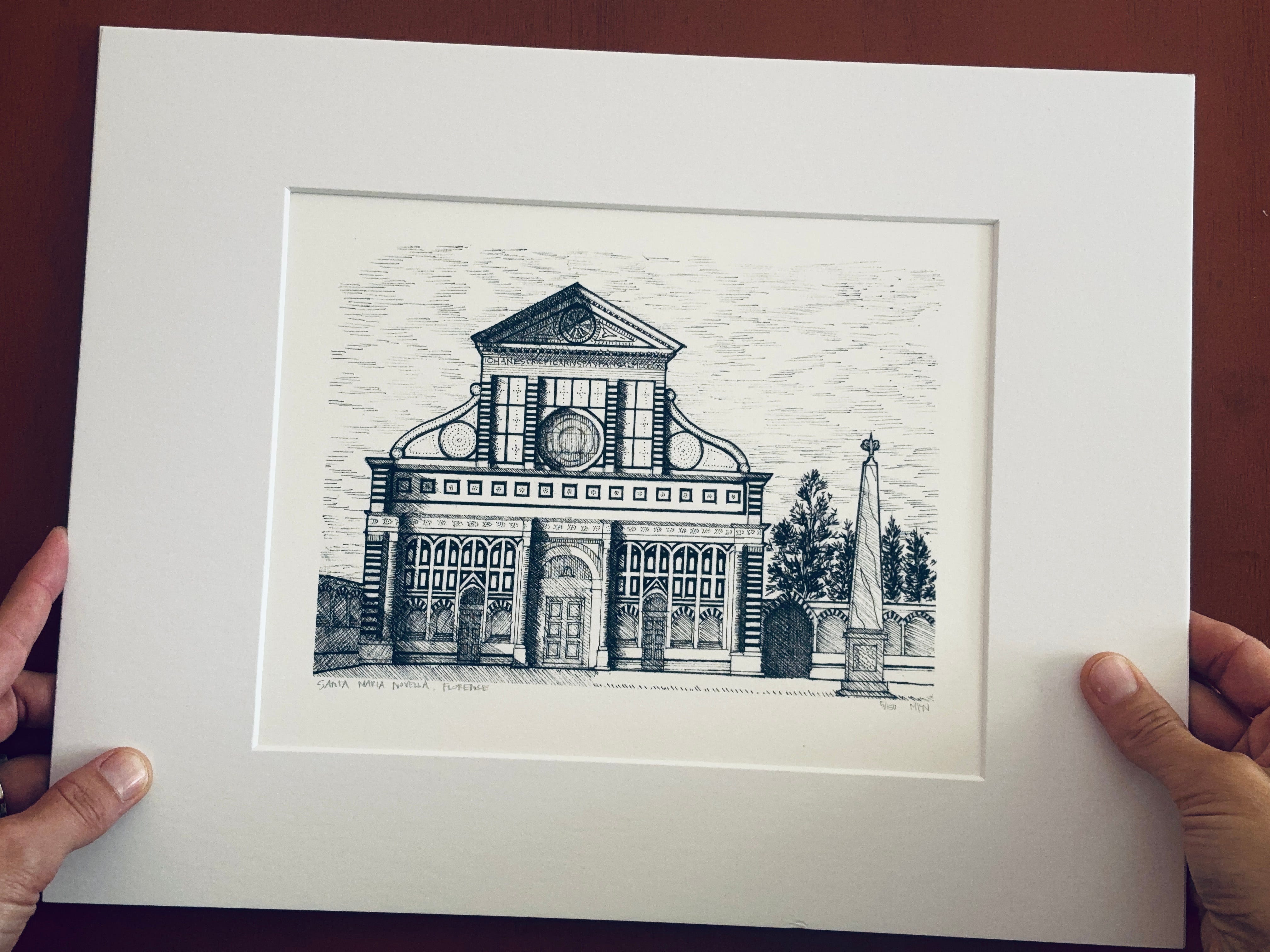
The finished illustration is now available as a limited edition print!
Santa Maria Novella Prints
For those who would like to bring the wonder of Santa Maria Novella home, I’ve released a limited edition of 150 signed prints each matted to 11” x 14”.
Join the Places of Wonder Mail Club
For those who want to stay curious and enchanted about the world around you.
As a member, every month you’ll receive:


One of my pen illustrations as a Place of Wonder postcard
The incredible story behind its architecture and history
The mail club is now shipping worldwide!
The yearly subscription makes a great gift.
To receive next month’s edition become a paid subscriber.
Next Thursday: A journey through Gothic architecture in three buildings
Mary
P.S. I’ll be at the Makers Market at the Mill Valley Lumber Yard this Saturday September 12th, with (two!) new illustrations from 11am - 5pm. And many others including fan favorites like Mont Saint Michel and Neuschwanstein.
Are you in the SF Bay Area? If so, come on by!
I’m Mary, an illustrator and former architect.
I share the stories and drawings of remarkable places to help you never lose your sense of wonder.
Just discovered your page, and what a brilliant idea to pair illustrations with the history of these places. Your drawings are beautiful. Keep up the great work!
I especially like this one Mary!